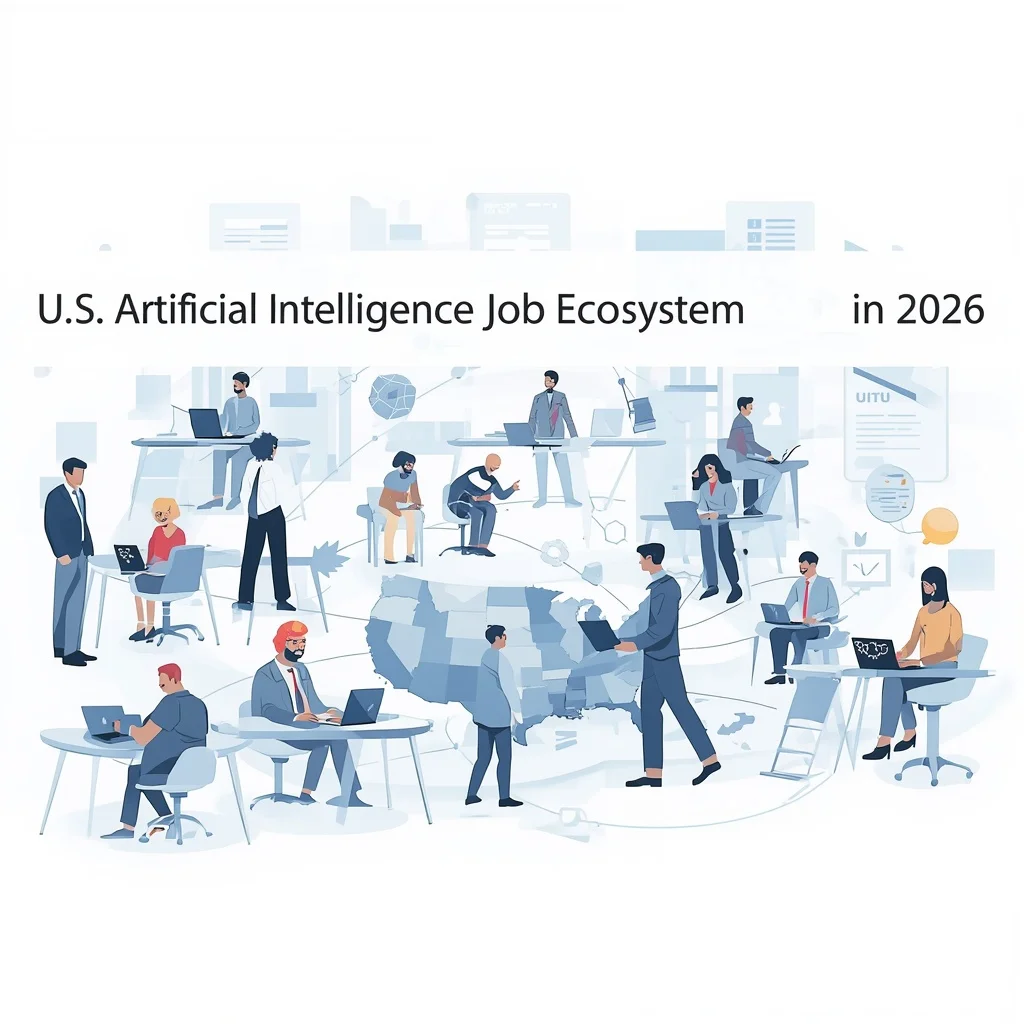
Artificial intelligence is changing how companies in the United States build products, analyze information, serve customers, and automate business processes. As AI adoption expands across technology, finance, healthcare, manufacturing, retail, cybersecurity, and professional services, the demand for people who can build, deploy, manage, and apply AI systems is also creating new career paths.
However, an AI career is not limited to becoming a machine learning engineer. The U.S. AI job market includes technical positions, research roles, data-focused careers, product positions, and business-oriented jobs.
This guide explores some of the most important AI jobs in the USA in 2026, what these professionals do, where they work, and what skills employers commonly look for.
What Makes AI Jobs Different in 2026?
The AI employment landscape has expanded beyond traditional machine learning.
Companies are now working with:
- Generative AI applications
- Large language models
- AI-powered search
- Autonomous AI agents
- Computer vision
- Predictive analytics
- AI automation
- AI infrastructure
- Model evaluation
- AI governance
- Responsible AI systems
This means companies need different types of professionals at different stages of the AI development cycle.
A startup may need an AI engineer who can integrate an existing model into its application, while a large technology company may employ dedicated researchers, infrastructure engineers, data scientists, and AI product managers.
For an overview of how AI is becoming part of wider business modernization, see our guide to AI in Digital Transformation.
1. AI Engineer
AI engineers develop software applications that use artificial intelligence models and services.
Their work can include integrating language models into applications, creating AI-powered features, developing intelligent workflows, and connecting models with databases or other software systems.
Typical responsibilities include:
- Integrating AI models through APIs
- Building AI-powered applications
- Creating model-driven workflows
- Working with structured and unstructured data
- Testing AI functionality
- Improving application performance
- Connecting AI systems with existing software
AI engineers can work in technology companies, financial services, healthcare, e-commerce, SaaS, consulting, and other industries.
2. Machine Learning Engineer
Machine learning engineers focus on developing and operating machine learning systems.
Their work often involves taking models from experimentation into reliable production environments.
Responsibilities can include:
- Preparing training data
- Developing machine learning models
- Training and evaluating models
- Optimizing model performance
- Building prediction systems
- Deploying models
- Monitoring production systems
This role is particularly relevant to companies that use machine learning as a core part of their products or internal operations.
3. Data Scientist
Data scientists use data, statistics, and computational techniques to answer business and operational questions.
Although data science is broader than artificial intelligence, many modern data science positions involve machine learning and predictive modeling.
A data scientist may work on:
- Customer behavior analysis
- Forecasting
- Risk analysis
- Fraud detection
- Recommendation systems
- Experimentation
- Business intelligence
Industries such as banking, insurance, healthcare, retail, logistics, and technology frequently use data-driven decision-making.
4. AI Research Scientist
AI research scientists work on developing new approaches to artificial intelligence.
Unlike application-focused AI positions, research roles can involve creating or improving algorithms, model architectures, training techniques, and evaluation methods.
Research areas may include:
- Natural language processing
- Computer vision
- Reinforcement learning
- Generative models
- Multimodal AI
- AI reasoning
- Model efficiency
These positions are commonly associated with major technology companies, dedicated AI research organizations, universities, and research laboratories.
Strong research and mathematical backgrounds are generally important for this career path.
5. Generative AI Engineer
Generative AI has created specialized engineering opportunities around systems that generate text, code, images, audio, and other content.
A generative AI engineer may develop applications around large language models or other foundation models.
Typical work includes:
- LLM application development
- Retrieval-augmented generation
- Embedding systems
- Vector search
- Prompt and response evaluation
- AI agents
- Model API integration
- Generative AI testing
The role can overlap with AI engineering, but its primary focus is on applications built around generative models.
The rapid development of AI tools is also changing how businesses approach software and automation. Our AI tools for 2026 article covers this broader ecosystem.
6. AI Product Manager
Not every AI professional needs to be a full-time programmer.
AI product managers connect business requirements, customer needs, engineering teams, and AI capabilities.
They may be responsible for:
- Defining AI product requirements
- Researching customer problems
- Prioritizing features
- Coordinating technical teams
- Measuring product performance
- Managing AI-related risks
- Explaining AI capabilities to stakeholders
This role is particularly useful for people who combine technology knowledge with product management and communication skills.
7. MLOps Engineer
Machine learning systems require infrastructure, deployment processes, monitoring, and maintenance.
MLOps engineers help create the systems required to operate machine learning models reliably.
Their responsibilities can involve:
- Model deployment
- Automated pipelines
- Infrastructure management
- Model monitoring
- Version control
- Data pipelines
- Performance monitoring
- Production troubleshooting
MLOps becomes particularly important when an organization operates many models or processes large amounts of data.
8. AI Solutions Architect
AI solutions architects design how artificial intelligence fits into an organization’s existing technology environment.
They may evaluate:
- AI models
- Cloud services
- Databases
- APIs
- Security requirements
- Data architecture
- Integration strategies
Instead of focusing on a single model, the architect considers the complete technical system.
This can be valuable for large organizations that need to introduce AI into existing enterprise infrastructure.
9. Computer Vision Engineer
Computer vision engineers build systems that process and understand visual information.
Applications can include:
- Manufacturing inspection
- Medical imaging
- Security systems
- Retail analytics
- Robotics
- Autonomous technologies
- Image search
The work may involve image classification, object detection, image segmentation, video analysis, and other computer vision techniques.
10. Natural Language Processing Engineer
Natural language processing specialists work with systems that process human language.
Traditional NLP applications include:
- Text classification
- Sentiment analysis
- Search
- Information extraction
- Translation
- Speech-related applications
Modern NLP work increasingly overlaps with large language models and generative AI.
Professionals in this area may work on enterprise search, customer-support systems, document processing, AI assistants, and language-based products.
11. AI Security Specialist
As organizations deploy more AI systems, security becomes an important part of implementation.
AI security specialists can work on protecting models, applications, data, and AI infrastructure.
Areas of interest include:
- Prompt injection
- Data security
- Model abuse
- Access control
- Adversarial attacks
- AI application security
- Privacy protection
The role can overlap with traditional cybersecurity while introducing risks specific to AI systems.
12. AI Governance and Compliance Roles
AI adoption also creates demand for professionals who understand how organizations should manage AI responsibly.
AI governance work can involve:
- AI policies
- Risk assessment
- Documentation
- Model oversight
- Data governance
- Compliance processes
- AI usage standards
- Human oversight
These roles can be particularly relevant to highly regulated industries where organizations need documented processes around technology and data.
Which Industries Hire AI Professionals in the USA?
AI careers are spread across many sectors rather than being limited to Silicon Valley technology companies.
Technology
Technology companies use AI for search, recommendation systems, software development, cloud services, customer support, cybersecurity, and product personalization.
Financial Services
Banks and financial companies can use AI for fraud detection, risk analysis, customer service, document processing, and financial forecasting.
Healthcare
Healthcare organizations use AI-related technologies for areas such as medical imaging, administrative automation, research, patient support, and data analysis.
Manufacturing
Manufacturers can apply AI to predictive maintenance, quality control, robotics, supply-chain planning, and production optimization.
Retail and E-Commerce
Retail companies use AI for recommendations, demand forecasting, inventory management, customer service, and personalization.
Professional Services
Consulting, legal, accounting, marketing, and other professional-service organizations are increasingly exploring AI for research, document analysis, workflow automation, and knowledge management.
Skills Employers Look for in AI Candidates
The required skills depend heavily on the job.
For engineering roles, employers may look for:
- Python
- Machine learning
- Software engineering
- APIs
- Databases
- Cloud platforms
- Data structures
- Model deployment
For data-focused positions:
- Statistics
- SQL
- Data analysis
- Machine learning
- Data visualization
- Business analysis
For AI product positions:
- Product management
- AI concepts
- User research
- Communication
- Product strategy
- Technical understanding
For AI governance roles:
- Risk management
- Data governance
- Documentation
- Regulatory awareness
- AI systems knowledge
This is why job seekers should examine individual job descriptions rather than assuming every AI position requires exactly the same qualifications.
Do You Need a Computer Science Degree for an AI Job?
A degree can be valuable for many technical positions, particularly research-oriented roles, but the requirements vary between employers and job types.
A candidate’s practical experience can also be demonstrated through:
- Open-source contributions
- GitHub projects
- Research work
- Internships
- Professional software experience
- AI applications
- Technical writing
- Industry certifications
Research-heavy positions may place greater emphasis on advanced academic qualifications, while application-focused positions can place more emphasis on practical engineering ability.
How Beginners Can Enter the U.S. AI Job Market
The route into AI depends on your existing background.
A software developer might transition into AI engineering by learning model APIs, machine learning systems, and AI application development.
A data analyst could move toward data science by developing stronger statistical and machine learning capabilities.
A product professional could specialize in AI product management.
A cybersecurity professional could focus on AI security.
This means entering AI does not always require starting an entirely new career from zero.
Remote AI Jobs in the USA
Some AI-related positions can be performed remotely, particularly software engineering, data analysis, AI application development, and certain consulting roles.
However, remote availability depends on the employer, role, security requirements, location restrictions, and employment arrangements.
Candidates should check each job posting for its actual work-location requirements rather than assuming that an AI position is automatically remote.
How AI Jobs May Continue to Change
The AI job market is evolving alongside the technology itself.
Some traditional software and data roles are incorporating AI into their workflows, while new specialties continue to appear around generative AI, AI agents, evaluation, security, governance, and infrastructure.
The future of AI work is therefore likely to involve both specialized AI professionals and workers in other disciplines who use AI as part of their regular responsibilities.
Our Droven.io technology blog can be useful for following broader technology developments related to this changing landscape.
Choosing an AI Career Path
There is no single AI job that fits everyone.
Someone who enjoys building production software may prefer AI engineering. A person interested in research may pursue machine learning research. Someone focused on business problems could explore AI product management or AI solutions architecture.
The important step is to match your existing strengths with the type of AI work you want to perform.
Instead of choosing a job title simply because it contains the word “AI,” examine the actual responsibilities, required skills, work environment, and long-term learning requirements.
Conclusion
The best AI jobs in the USA in 2026 span much more than machine learning engineering. AI engineers, machine learning engineers, data scientists, research scientists, generative AI engineers, product managers, MLOps engineers, solutions architects, security specialists, and governance professionals can all contribute to the AI ecosystem.
The U.S. AI job market is also becoming more diverse as organizations in finance, healthcare, manufacturing, retail, technology, and professional services adopt AI for different purposes.
For aspiring professionals, the most practical approach is to identify a specific type of AI work, study the skills required for that role, and build evidence of those skills through relevant projects or professional experience. As AI continues to evolve, the ability to understand and apply the technology to real-world problems will remain an important part of building an AI-focused career.