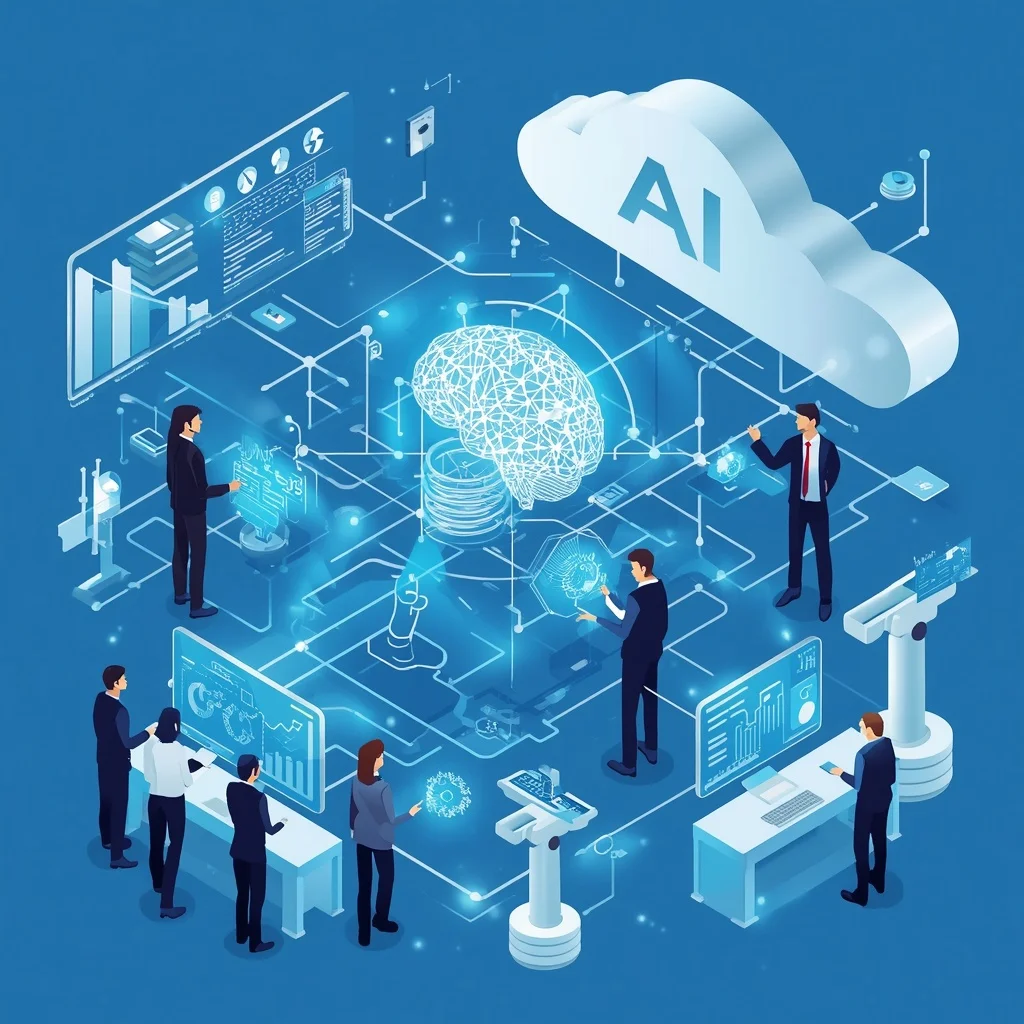
Artificial intelligence (AI) has become an important part of digital transformation for businesses across industries. Companies are no longer using digital technologies only to move existing processes online. They are using AI to automate repetitive work, analyze large amounts of data, improve customer experiences, and support faster business decisions.
The connection between AI and digital transformation is particularly important because modern organizations need more than basic software upgrades. They need systems that can learn from data, identify patterns, generate useful insights, and help employees work more efficiently.
This guide explains how AI supports digital transformation, where businesses can use it, its benefits and challenges, and how organizations can build a practical AI-driven transformation strategy.
What Is Digital Transformation?
Digital transformation is the process of using digital technologies to improve how a business operates, serves customers, manages information, and creates value.
It can involve technologies such as:
- Cloud computing
- Artificial intelligence
- Machine learning
- Automation
- Data analytics
- Internet of Things (IoT)
- Mobile applications
- Enterprise software
- Cybersecurity platforms
Digital transformation is not simply about buying new software. It often requires changes to business processes, employee workflows, customer interactions, and decision-making.
For example, a company might move from manually processing customer requests to using a cloud-based customer management system. Adding AI can take this transformation further by automatically categorizing requests, identifying customer intent, and recommending appropriate responses.
How AI Fits Into Digital Transformation
AI adds intelligence to digital systems. Traditional software generally follows predefined rules, while AI systems can analyze data and identify patterns that help businesses automate decisions or generate useful outputs.
This makes AI a powerful component of digital transformation.
Businesses can use AI to:
- Automate repetitive tasks
- Analyze customer and operational data
- Predict demand
- Personalize customer experiences
- Detect unusual activity
- Generate content and documentation
- Support employees with AI assistants
- Improve business forecasting
- Optimize workflows
For organizations researching droven. io ai in digital transformation, the key concept is understanding that AI works best when it is connected to broader business processes rather than treated as an isolated technology.
Businesses should first identify a process that needs improvement and then determine whether AI can create measurable value.
Major Applications of AI in Digital Transformation
1. Intelligent Business Automation
Automation is one of the most common applications of AI in digital transformation.
Traditional automation can perform predefined actions, but AI-powered automation can handle more complex information and situations. For example, an AI system can read incoming documents, classify them, extract relevant information, and send the data to another business system.
Organizations can use intelligent automation for:
- Invoice processing
- Document classification
- Email management
- Customer support
- Data entry
- Report generation
- Workflow management
Businesses interested in this area can also explore our guide to AI tools for business for a broader look at how AI technologies can support modern workflows.
2. Customer Experience
AI can help companies create more responsive and personalized customer experiences.
AI-powered chatbots and virtual assistants can answer common questions, guide users through websites, and provide support outside normal business hours. Recommendation systems can also use customer behavior and preferences to deliver more relevant products, services, or content.
For example, an online retailer could use AI to analyze browsing and purchasing patterns and recommend products that match a customer’s interests.
AI can also analyze customer feedback to identify recurring complaints and areas where service quality could be improved.
3. Data Analysis and Business Intelligence
Modern businesses generate enormous amounts of data from websites, applications, sales systems, customer interactions, and internal operations.
Analyzing all this information manually can be difficult and time-consuming.
AI can help identify patterns within large datasets and provide insights that support business decisions. Machine learning models can also be used to identify relationships and trends that may not be immediately visible through traditional analysis.
This can help organizations with:
- Demand forecasting
- Customer segmentation
- Sales analysis
- Risk detection
- Performance monitoring
- Market analysis
AI should not replace responsible human decision-making, but it can make large amounts of business information easier to understand.
4. Marketing and Personalization
Digital transformation has changed how companies approach marketing, and AI is adding another layer of automation and personalization.
AI can help marketers analyze audience behavior, identify content opportunities, automate parts of campaign management, and personalize communications.
For example, an e-commerce company can use AI to analyze customer behavior and create different recommendations for different customer segments.
AI can also support content research and optimization, although businesses should maintain human review to ensure accuracy, originality, and brand consistency.
5. Predictive Maintenance
Manufacturing, transportation, energy, and other industries can use AI to predict potential equipment problems.
Instead of waiting for machinery to fail, organizations can analyze sensor data and historical maintenance information to identify signs of potential failure.
Predictive maintenance can help businesses:
- Reduce unexpected downtime
- Improve equipment utilization
- Plan maintenance activities
- Reduce unnecessary repairs
- Improve operational efficiency
This is an example of how AI can transform a reactive business process into a more proactive one.
Benefits of AI-Driven Digital Transformation
AI can create several potential benefits when implemented around clear business objectives.
Improved Efficiency
AI can automate repetitive activities and allow employees to spend more time on complex tasks that require judgment, creativity, or communication.
Faster Decision-Making
AI systems can process large datasets quickly and provide insights that help teams evaluate business situations more efficiently.
Better Customer Service
AI assistants and automated support systems can provide faster responses to common customer questions while helping human support teams focus on more complicated cases.
Reduced Operational Costs
Automation can reduce the amount of manual work required for repetitive processes. The actual cost savings depend on implementation, infrastructure, maintenance, and the specific business process being automated.
More Personalized Experiences
AI can analyze customer behavior and preferences to help businesses provide more relevant recommendations and communications.
Scalable Operations
AI-powered systems can help businesses handle increasing volumes of data, requests, or transactions without requiring every process to scale through manual labor.
AI and Cloud Computing
Cloud computing is an important foundation for many digital transformation projects.
Cloud platforms provide businesses with scalable computing resources, storage, databases, and software services. AI workloads can also use cloud infrastructure to process large datasets and deploy machine learning applications.
The combination of cloud computing and AI can make advanced technologies more accessible to businesses that do not want to maintain all computing infrastructure themselves.
For a broader introduction to cloud technologies, see our Cloud Computing Guide.
AI and Digital Transformation in 2026
AI adoption continues to influence how businesses approach technology investments in 2026.
Generative AI, AI assistants, machine learning, intelligent automation, and AI-powered analytics are increasingly being considered as part of broader technology strategies.
However, successful transformation is not simply about adopting the newest AI model or tool.
Businesses need to consider:
- The problem they want to solve
- The quality of available data
- Integration with existing systems
- Security requirements
- Employee workflows
- Customer impact
- Cost of implementation
- Governance and human oversight
This approach helps organizations avoid implementing AI simply because it is popular.
Our article on How AI Is Powering Business provides additional context on how businesses can apply AI to practical business use cases.
Challenges of Using AI in Digital Transformation
Although AI offers significant opportunities, implementation also comes with challenges.
Data Quality
AI systems depend heavily on data. Inaccurate, incomplete, outdated, or poorly structured data can reduce the quality of AI-generated results.
Integration
Many organizations already use multiple business applications. Connecting AI solutions with existing systems can require technical planning and development.
Security and Privacy
Businesses need to understand how data is collected, stored, processed, and accessed when implementing AI systems.
Sensitive information requires appropriate security controls and policies.
Employee Adoption
Employees may need training to understand how new AI systems work and how their responsibilities will change.
Technology adoption is more effective when employees understand how the new tools support their work rather than simply viewing AI as another software requirement.
Cost and Infrastructure
AI projects can involve costs related to software, cloud infrastructure, development, integration, maintenance, and employee training.
Organizations should therefore evaluate expected business value before committing to large-scale implementation.
How to Build an AI Digital Transformation Strategy
A practical strategy can begin with a small number of clearly defined use cases.
Step 1: Identify Business Problems
Start by identifying inefficient processes, customer service problems, data challenges, or repetitive tasks.
Step 2: Evaluate AI Opportunities
Determine whether AI can realistically improve the selected process. Not every business problem requires AI.
Step 3: Prepare the Data
Review data quality, availability, security, and accessibility before developing an AI solution.
Step 4: Select the Right Technology
Depending on the use case, an organization may need machine learning, generative AI, predictive analytics, intelligent automation, or another technology.
Step 5: Start With a Pilot
A limited pilot can help a business evaluate performance before expanding an AI system across the organization.
Step 6: Measure Results
Define measurable indicators such as processing time, customer response time, error rates, operational costs, or employee productivity.
Step 7: Scale Gradually
Once a solution demonstrates value, businesses can integrate it into additional workflows and departments.
The Role of Employees in AI Transformation
AI does not eliminate the need for people in digital transformation. In many cases, employees remain essential for reviewing AI outputs, making complex decisions, managing customers, and handling exceptions.
Organizations should consider AI as a technology that can augment human capabilities.
For example, an AI assistant might summarize a large collection of documents, while an employee reviews the summary and makes the final business decision.
This human-in-the-loop approach can improve oversight and reduce the risks associated with relying entirely on automated outputs.
AI, Automation, and the Future of Business
AI and automation are likely to remain important parts of business technology strategies.
Organizations are moving toward workflows in which software can collect information, analyze it, recommend actions, and automate selected processes.
However, the most sustainable approach is usually based on business requirements rather than technology trends.
Companies that clearly define their objectives, prepare their data, select suitable technologies, and measure results can build a stronger foundation for AI adoption.
For businesses exploring AI automation specifically, our guide to AI automation tools for modern businesses covers additional applications and technologies.
Conclusion
AI is becoming an important component of digital transformation because it can add intelligence to business processes that were previously manual, rule-based, or difficult to analyze.
From automation and customer service to data analysis, marketing, predictive maintenance, and decision support, AI can contribute to digital transformation across many industries.
The most important consideration is not simply whether a business can use AI, but whether AI can solve a meaningful business problem and produce measurable value.
A successful AI transformation strategy combines technology with high-quality data, secure systems, employee involvement, clear objectives, and continuous measurement. By taking this practical approach, businesses can use AI as part of a broader digital transformation strategy rather than treating it as a standalone technology.
Discussion