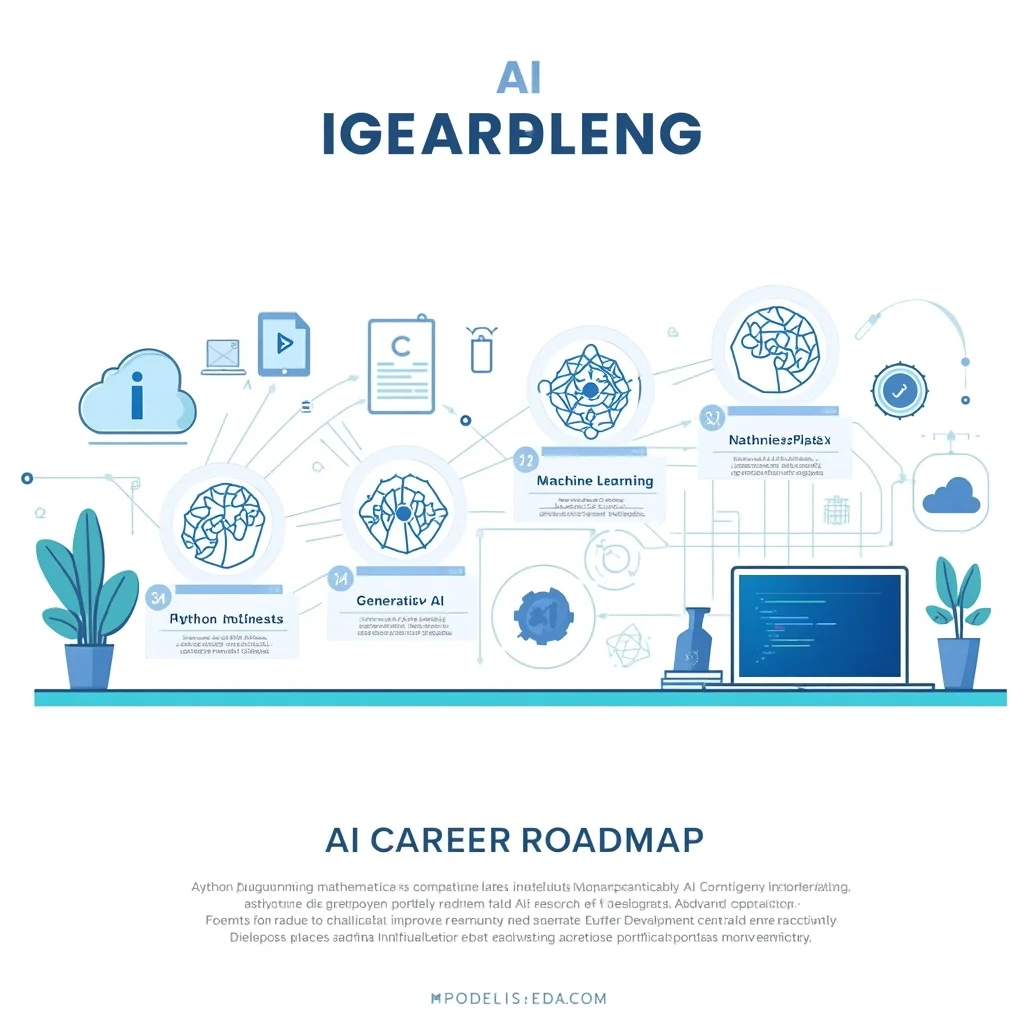
Artificial intelligence has become one of the most important areas of technology, creating opportunities across software development, data science, automation, cybersecurity, business intelligence, robotics, and many other fields. For beginners, however, entering AI can feel overwhelming because the field includes mathematics, programming, machine learning, data, cloud computing, and rapidly evolving AI tools.
A clear AI career roadmap can make the process easier by breaking the journey into practical stages. You do not need to master every area of artificial intelligence at once. Instead, you can build a strong technical foundation, choose a specialization, create practical projects, and gradually develop the skills required for your target role.
What Is an AI Career Roadmap?
An AI career roadmap is a structured learning and development path that helps someone move from basic technical knowledge toward an artificial intelligence career.
The exact path depends on the role you want to pursue. Someone interested in machine learning engineering will need stronger programming and mathematics skills, while someone working with AI automation may focus more on APIs, workflows, business processes, and AI tools.
A typical roadmap includes:
- Programming fundamentals
- Mathematics and statistics
- Data handling
- Machine learning
- Deep learning
- Generative AI
- AI tools and frameworks
- Practical projects
- Cloud and deployment skills
- Portfolio development
- Job preparation
Understanding where AI fits into broader technology trends can also be useful. For example, businesses increasingly use AI as part of their wider digital transformation strategies.
For more background, see our guide to AI in Digital Transformation.
Step 1: Understand the AI Landscape
Before learning technical skills, understand what artificial intelligence actually includes.
AI is a broad field containing several related areas:
Machine Learning
Machine learning allows systems to learn patterns from data and make predictions or decisions without being explicitly programmed for every situation.
Common applications include:
- Recommendation systems
- Fraud detection
- Customer prediction
- Image classification
- Demand forecasting
Deep Learning
Deep learning is a branch of machine learning that uses neural networks with multiple layers. It plays an important role in computer vision, speech recognition, natural language processing, and modern generative AI.
Natural Language Processing
Natural language processing focuses on enabling computers to understand and generate human language. Chatbots, translation systems, text classification, and AI writing systems are common examples.
Computer Vision
Computer vision enables machines to interpret images and video. It is used in areas such as medical imaging, security systems, manufacturing, autonomous systems, and visual search.
Generative AI
Generative AI can produce text, images, audio, video, code, and other types of content.
Understanding these categories helps beginners identify which part of AI interests them before committing to a specialization.
Step 2: Learn Programming Fundamentals
Programming is one of the most important foundations for a technical AI career.
Python is commonly used in AI and machine learning because of its extensive ecosystem and relatively accessible syntax.
Start with:
- Variables and data types
- Conditional statements
- Loops
- Functions
- Lists, dictionaries, and sets
- Object-oriented programming
- File handling
- Error handling
- Modules and packages
- Basic APIs
After learning the fundamentals, practice by building small programs instead of only watching tutorials.
For example, you could create a simple data analyzer, text-processing application, recommendation prototype, or API-based AI application.
Step 3: Build a Foundation in Mathematics
You do not necessarily need advanced mathematics to begin exploring AI, but mathematical fundamentals become increasingly important as you move into machine learning and research-oriented roles.
Focus on three main areas.
Linear Algebra
Learn concepts such as:
- Vectors
- Matrices
- Matrix operations
- Dot products
- Dimensions
Linear algebra is particularly useful for understanding how machine learning models process data.
Probability and Statistics
Important concepts include:
- Mean and median
- Variance and standard deviation
- Probability distributions
- Correlation
- Sampling
- Hypothesis testing
- Basic statistical interpretation
Calculus
For deeper machine learning knowledge, understand concepts such as derivatives, gradients, and optimization.
You do not need to learn every mathematical topic before writing your first machine learning program. Learn the mathematics progressively as the concepts become relevant.
Step 4: Learn Data Handling
AI systems depend heavily on data, making data-handling skills an important part of the roadmap.
Learn how to:
- Load datasets
- Clean missing data
- Remove duplicates
- Transform variables
- Analyze distributions
- Visualize data
- Split datasets
- Identify data-quality problems
Python libraries such as NumPy, pandas, and Matplotlib can help you develop these skills.
SQL is also valuable because many real-world AI systems depend on databases and structured business data.
Step 5: Learn Machine Learning
Once your programming and data foundations are strong enough, move into machine learning.
Start with supervised and unsupervised learning.
Supervised Learning
In supervised learning, models learn from labeled examples.
Common algorithms include:
- Linear regression
- Logistic regression
- Decision trees
- Random forests
- Support vector machines
- Gradient boosting
Unsupervised Learning
Unsupervised learning works with data where predefined labels are not available.
Common techniques include:
- Clustering
- Dimensionality reduction
- Association analysis
You should also understand model evaluation. Accuracy alone is not always enough. Depending on the problem, precision, recall, F1 score, mean squared error, and other metrics may be more appropriate.
Step 6: Explore Deep Learning
After developing a machine learning foundation, you can move into deep learning.
Learn the basic concepts behind:
- Neural networks
- Activation functions
- Loss functions
- Backpropagation
- Optimization
- Convolutional neural networks
- Recurrent neural networks
- Transformers
Frameworks such as PyTorch and TensorFlow are commonly used for building and training deep learning models.
You do not need to learn every framework. Choose one and become comfortable building practical projects with it.
Step 7: Learn Generative AI and Modern AI Tools
Generative AI has introduced another important area for people entering the AI industry.
Depending on your goals, explore:
- Large language models
- Prompt design
- Embeddings
- Vector databases
- Retrieval-augmented generation
- AI agents
- Model APIs
- Fine-tuning concepts
- Multimodal AI
- AI automation workflows
You can also study different AI tools and their business applications. Our AI tools for 2026 guide provides another useful starting point for exploring this rapidly changing area.
For historical comparison, you can also review AI tools from 2025.
Step 8: Choose an AI Career Specialization
After exploring the fundamentals, choose a direction rather than trying to become an expert in everything.
Machine Learning Engineer
This role typically involves developing, training, testing, and deploying machine learning models.
Useful skills include:
- Python
- Machine learning
- Data structures
- Model evaluation
- APIs
- Cloud platforms
- MLOps
Data Scientist
Data scientists use statistics, programming, and machine learning to analyze data and support decision-making.
Important skills include:
- Python or R
- SQL
- Statistics
- Data visualization
- Machine learning
- Business analysis
AI Engineer
AI engineers often build applications that integrate AI models into software products.
Useful areas include:
- Python
- APIs
- Machine learning
- Generative AI
- Cloud services
- Application development
AI Automation Specialist
This path focuses on using AI to automate business processes and workflows.
Skills may include:
- AI APIs
- Workflow automation
- Prompt engineering
- Data integration
- Business process analysis
- No-code and low-code automation platforms
AI is increasingly becoming part of broader business strategies, which makes understanding AI for business useful for this career direction.
AI Researcher
AI research is generally more mathematics- and research-intensive. It can involve developing new algorithms, architectures, training methods, or approaches to solving AI problems.
This path typically requires deeper knowledge of mathematics, machine learning, and academic research.
Step 9: Build Real AI Projects
Projects are one of the most useful ways to demonstrate what you can actually do.
Instead of creating dozens of small tutorial projects, build several projects that solve realistic problems.
Examples include:
- AI chatbot
- Document question-answering system
- Recommendation engine
- Image classification application
- Customer sentiment analyzer
- Sales prediction model
- AI-powered search system
- Automated reporting tool
- Resume analysis application
- Business workflow automation system
Each project should explain the problem, data, technology, implementation process, and results.
Publish suitable projects on GitHub and create clear documentation so another person can understand how the system works.
Step 10: Learn Cloud and AI Deployment
Building a model locally is only part of the process. Professional AI applications often need to run in production environments.
Learn the basics of:
- Cloud computing
- APIs
- Containers
- Databases
- Model serving
- Authentication
- Monitoring
- Version control
- CI/CD
Cloud platforms can provide computing resources for training and deploying AI applications.
Understanding cloud technology can therefore complement an AI career, particularly for AI engineering and machine learning engineering roles.
Step 11: Develop a Professional AI Portfolio
Your portfolio should demonstrate practical ability rather than simply list technologies.
For each project, include:
- The problem you solved
- Your approach
- Technologies used
- Dataset or data source
- Important implementation decisions
- Results
- Screenshots or demonstrations
- GitHub repository where appropriate
A smaller portfolio of well-explained projects can provide more useful evidence of your skills than a large collection of unfinished tutorials.
Step 12: Prepare for AI Jobs
Once you have a foundation and portfolio, begin preparing for relevant positions.
Review job descriptions for your target role and identify recurring requirements.
For technical roles, preparation may include:
- Python programming
- Data structures and algorithms
- Machine learning concepts
- SQL
- Statistics
- System design
- Model evaluation
- AI fundamentals
For AI automation or business-focused roles, practical workflow development, APIs, business process understanding, and communication may receive greater emphasis.
Do not wait until you believe you know everything before applying. The requirements of individual roles vary considerably.
Common Mistakes Beginners Make
Following an AI career roadmap does not mean learning every technology available.
Several common mistakes can slow progress.
Trying to Learn Everything
AI is too broad to master all at once. Choose a direction after gaining basic exposure to the major areas.
Focusing Only on Courses
Courses can provide structure, but practical projects are necessary for applying knowledge.
Ignoring Fundamentals
Using AI tools without understanding programming, data, or basic machine learning can make it difficult to troubleshoot complex problems.
Chasing Every New AI Tool
The AI ecosystem changes quickly. Focus on transferable concepts rather than attempting to learn every newly released tool.
Building Projects Without Understanding Them
A portfolio is more useful when you can explain why you selected a particular model, how it works, what limitations it has, and how you evaluated it.
A Practical AI Career Roadmap
A simple progression could look like this:
Stage 1: Programming fundamentals
↓
Stage 2: Mathematics and statistics
↓
Stage 3: Data analysis and SQL
↓
Stage 4: Machine learning
↓
Stage 5: Deep learning
↓
Stage 6: Generative AI and modern AI systems
↓
Stage 7: Choose a specialization
↓
Stage 8: Build real-world projects
↓
Stage 9: Learn deployment and cloud fundamentals
↓
Stage 10: Build a portfolio and prepare for relevant jobs
The timeline will vary depending on your previous experience, available study time, and chosen specialization.
How to Stay Current in Artificial Intelligence
AI changes quickly, so learning should continue after you get your first role.
Follow:
- Research papers
- Official documentation
- Developer communities
- Open-source projects
- Technical blogs
- AI conferences
- Model and framework releases
Focus on understanding why new technologies matter instead of simply collecting tools.
Our Droven.io technology blog can also be explored alongside other technology-focused resources when researching developments in AI and related fields.
Conclusion
Breaking into artificial intelligence is a gradual process rather than a single course or certification. A strong AI career roadmap starts with programming and data fundamentals, develops into machine learning and modern AI technologies, and then moves toward a specific career specialization.
The most useful approach is to combine structured learning with practical projects. Build systems, analyze real data, experiment with AI models, document your work, and continue developing skills that remain useful as individual tools and platforms change.
Whether your goal is machine learning engineering, data science, AI development, automation, or research, a focused learning path can help turn broad interest in artificial intelligence into practical technical capability.