
Most small business customers do not start with a brand name. They start with a search like “plumber near me,” “best coffee shop in Austin,” or “dentist open now.” If your business does not show up in those results, those customers will call someone else, even if your work is better.
That is what local SEO is for. It is the work of making a business easy to find when people nearby are ready to buy. It is not about ranking across the whole country. It is about winning the searches that happen in your city, your neighborhood, and the towns around you.
This guide explains how local SEO works, what Google looks at, and the exact steps a US small business can follow to get found, get called, and get chosen.
What Is Local SEO?
Local SEO is search engine optimization for businesses that serve customers in a specific place. When someone searches for a service near them, Google tries to show the most useful nearby options. It looks at three things: how relevant your business is to the search, how close you are to the searcher, and how well known and trusted your business appears to be.
That is why a small shop can outrank a large national chain in its own town. The chain may have a bigger website, but the local business has a real address, real reviews from local customers, and content that matches what people in that area actually search for.
Local SEO covers your Google Business Profile, your website pages, your reviews, your name, address, and phone number across the web, and the local links and mentions that show Google you are a real, active business in that area.
Why Local SEO Matters for US Small Businesses
Local searches are buying searches. Someone who types “emergency plumber near me” or “pizza delivery open now” is not doing research for next month. They need help today, and they will usually contact one of the first few businesses they see.
Showing up in the Google Maps results, often called the map pack, puts your business in front of those people before they ever visit your website. A strong local presence also builds trust fast. Star ratings, photos, opening hours, and recent reviews answer the first questions a new customer has, without a phone call.
For a small business, this is also one of the fairest ways to compete. You do not need a national advertising budget. You need accurate information, a helpful website, good service that earns reviews, and steady local content. That work compounds. Each review, each local page, and each correct listing makes the next local search a little easier to win.
If you want a broader view of how search work fits together, read our guide to search engine optimization for business websites.
How Google Decides Which Local Businesses to Show
Google has explained its local ranking in simple terms. Three factors matter most.
Relevance. Does your business match what the person searched for? Your Google Business Profile categories, your website content, and the services you list all help Google understand what you do.
Distance. How close is your business to the person searching, or to the place they searched for? You cannot change your address, but you can be clear about the areas you serve, so Google knows where you work.
Prominence. How well known is your business? Reviews, links from other local sites, news mentions, and a complete and active profile all add to prominence. A business with many recent, positive reviews will usually be shown more often than a similar business with none.
None of these factors works alone. A very close business with an empty profile can lose to a slightly farther business with strong reviews and a clear website. The goal is to be strong on all three.
Local SEO vs Traditional SEO vs PPC
Local SEO, traditional SEO, and paid ads all bring visitors, but they work in different ways and on different timelines.
| Channel | Best for | How fast it works | Cost pattern |
|---|---|---|---|
| Local SEO | Nearby customers ready to buy | Weeks to months | Work up front, then steady traffic |
| Traditional SEO | Broader, non-local topics | Months | Work up front, then steady traffic |
| PPC ads | Immediate visibility and testing | Days | Pay for every click |
Most small businesses do best with local SEO as the base and paid ads when they need fast results. If you want to test a new service or area quickly, see our PPC management in the USA. For the long term, local SEO is the work that keeps bringing in calls after the ad budget is paused.
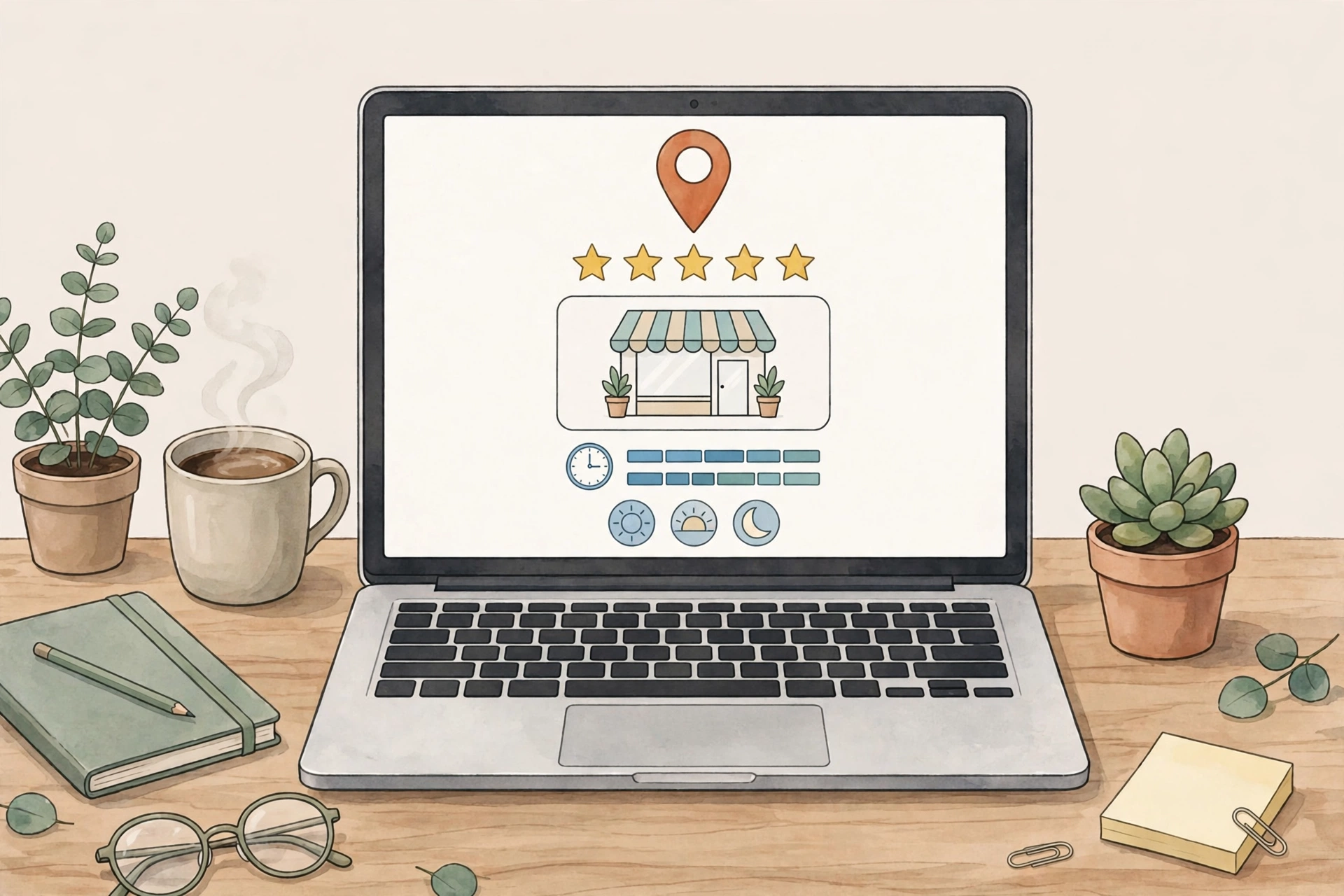
Step 1: Fix Your Google Business Profile First
Your Google Business Profile is the listing that appears in Google Maps and in the map pack. For many local businesses, it is more important than the homepage. Claim it, verify it, and complete every field.
Use your real business name, exactly as customers know it. Add your correct address, phone number, website, and opening hours, including holiday hours. Choose the most accurate primary category, then add useful secondary categories. Add your services with short, plain descriptions, and upload real photos of your shop, your team, and your work.
Then keep it active. Post updates when you have news, answer questions, and reply to reviews. A profile that was completed once and never touched again looks inactive. A profile with fresh photos and recent replies looks open, busy, and trustworthy.
Step 2: Keep Your Name, Address, and Phone Number Consistent
Google checks your business details across the web. If your address is written one way on your website, another way on Yelp, and a third way on Facebook, Google has less confidence in which one is right.
Pick one exact version of your name, address, and phone number, and use it everywhere: your website footer, your Google Business Profile, directories, social profiles, and invoices. If you move or change your number, update every listing, not just your website.
This is a small job, but it matters. Inconsistent details are one of the most common reasons a local business struggles to show up, even when its website looks good.
Step 3: Build Local Pages That Match Real Searches
One generic services page is rarely enough. People search by place and by problem, so your website should answer both.
Start with a clear service page for each main service, written for customers, not for search engines. Then add pages for the places you serve, if you genuinely work there. A page for each city or neighborhood should include real local detail: the areas you cover, the kind of work you do there, and how to contact you. Do not copy the same page and change only the city name. Google can tell, and customers can too.
Use the words customers use. A page titled with plain language, such as “plumbing services in Dallas” or “roof repair in Phoenix,” is easier to understand than a page full of industry terms. Add local photos, customer stories from that area, and a clear call to action.
The technical side matters here as well. Fast pages, a mobile-friendly layout, and clean titles help Google read and show your local pages. Our technical SEO guide explains the basics that support this work.
Step 4: Earn Reviews, and Reply to Every One
Reviews are one of the strongest local ranking signals, and they are also the first thing a new customer reads. A business with 80 recent reviews will usually win over a business with 4 old ones, even if the second business is closer.
Ask every happy customer for a review, at the moment they are happiest, usually right after the job is done. Make it easy: send a direct link, and do not offer payment or discounts for reviews. That breaks Google’s rules and can get reviews removed.
Reply to every review, good and bad. Thank happy customers by name and mention the work you did. For a bad review, stay calm, apologize for the experience, and offer a way to fix it offline. Future customers read your replies as closely as they read the reviews. A thoughtful reply to a complaint can win more trust than a perfect five-star record.
Step 5: Get Local Links and Mentions
Links from other local websites tell Google that your business is part of the community. You do not need hundreds of links. A small number of relevant local links is better than many unrelated ones.
Good starting points are your local chamber of commerce, local business directories, suppliers, partner businesses, and local news or community sites. Sponsor a local team or event, join a local business group, or offer a useful guide for your town. These real-world connections often turn into real links.
Avoid buying links or joining link schemes. They can hurt your rankings and are hard to undo. Local SEO is slow work, but the links you earn by being active locally tend to last.
Step 6: Track Calls, Directions, and Bookings, Not Just Rankings
Rankings alone do not pay the bills. Track what local SEO actually brings in: phone calls, direction requests, website visits from Maps, contact form fills, and bookings.
Your Google Business Profile shows calls, messages, and direction requests. Your website analytics show which local pages bring visitors and which ones lead to contact. Check these numbers every month. If a service page gets traffic but no calls, the page may need a clearer offer, better photos, or a simpler contact form.
Use that data to decide what to do next. If one city page is working, build the next one. If reviews are driving calls, ask for more reviews. Local SEO is a loop: improve, measure, and improve again.
Common Local SEO Mistakes to Avoid
First, do not stuff your business name with keywords. Adding “Best Plumber Dallas Cheap” to your Google Business Profile name breaks Google’s rules and can get your listing suspended. Use your real name.
Second, do not create fake locations. A virtual office or a mailbox address is not a real place of business. Google may remove the listing, and customers who visit will be disappointed.
Third, do not ignore your website. A strong Google Business Profile helps, but customers still click through to check your services, prices, and credibility. A slow or outdated website will lose the customers your profile won.
Fourth, do not buy reviews. Fake reviews are usually easy to spot, they get removed, and they can damage trust far more than a slow start with real reviews.
How to Choose a Local SEO Company
If you hire help, choose a provider that explains its work in plain language and reports on calls and leads, not only on rankings. Ask what they will do in the first 30 days, how they will earn reviews and local links, and how they will report results.
Be careful with anyone who promises the number one spot in a week, or who will not explain what they are doing. Local SEO takes time, and honest providers will say so. When comparing options, look at real local results, not only at national case studies. Our overview of local SEO companies shows the kind of local detail worth looking for, even though that example is from Australia.
If you want help with this work in the US, our Advanced SEO USA service and the full list of AelfTech services are a good place to start.
Frequently Asked Questions
How long does local SEO take?
Most small businesses see movement in 4 to 12 weeks, and stronger results in 3 to 6 months. The timeline depends on your competition, your starting point, and how much work is done each month.
Is local SEO different from regular SEO?
Yes. Regular SEO focuses on ranking web pages for broad topics. Local SEO focuses on ranking a business for nearby searches, in Maps and in local results, using your profile, reviews, and local pages.
Do I need a website for local SEO?
You can appear in Maps without a website, but a good website helps a lot. It gives Google more to understand about your services, and it gives customers a place to check your work before they call.
How many reviews do I need?
There is no fixed number. Aim to have more recent, positive reviews than your closest competitors, and keep new reviews coming in every month. Freshness matters as much as the total count.
Can I do local SEO myself?
Yes, for the basics. You can claim your profile, fix your listings, ask for reviews, and write local pages yourself. Many businesses hire help when they want faster progress, or when they need technical work and link building.
The Bottom Line
Local SEO is not a trick. It is a clear record of a real business: the right name and address everywhere, a complete Google Business Profile, helpful local pages, honest reviews, and steady local activity. Do that work well, and Google has every reason to show your business to the people nearby who need it.
Start with your profile and your listings today, then add one local page and ask your next five happy customers for a review. Those small steps are how small businesses get found, get called, and keep growing in their own town.
Discussion